
The Best Putting Training Aids of 2026 (Category by Category)
The best putting training aid depends on which of the three putting skills you're leaking: start line, face, or pace. A buyer's guide sorted by category and what each one actually fixes.
There is no single best putting training aid — there is the best aid for the skill you are leaking. Putting comes down to three things, and every aid on the market trains one of them (and usually only one). This is a buyer's guide sorted by category, so you buy for your actual problem instead of the flashiest ad.
The three skills every putting aid maps to
- Start line — does the ball launch where you aimed?
- Face control — is the putter square at impact?
- Pace — does the ball finish the right distance?
Line and face decide direction; pace decides three-putts. Before you buy, know which one is costing you the most. If your putts look on-line but you keep leaving them short or long, no start-line gadget will help you.
Gates and start-line aids
Gates (two tees or a molded gate) and start-line references train direction: a square face and an on-line start, with instant feedback when you clip a side. The most universal feedback tool in putting, and the right first purchase if your ball starts offline.
Mirrors
A putting mirror shows your eyes and shoulders at address. Setup errors cause more misses than stroke errors, so if you have never checked your eye line, a mirror fixes problems that happen before the putter even moves.
Path and arc trainers
Track and arc boards give the putter a rail or curve to follow, training a consistent stroke shape. Good for grooving path — the limit is that many only train the shape, not the face or the pace.
Tempo trainers
A metronome or weighted trainer builds a repeatable rhythm — the same beat on a five-footer and a forty-footer. Quietly one of the biggest separators, since amateurs rush the short ones and decelerate on the long ones.
Pace and distance aids — the category most people skip
Almost every putting aid trains line. Very few train pace — how far a given stroke rolls the ball — which is the skill that actually prevents three-putts. This is the gap in most golfers' practice and most golfers' gear.
The all-in-one option
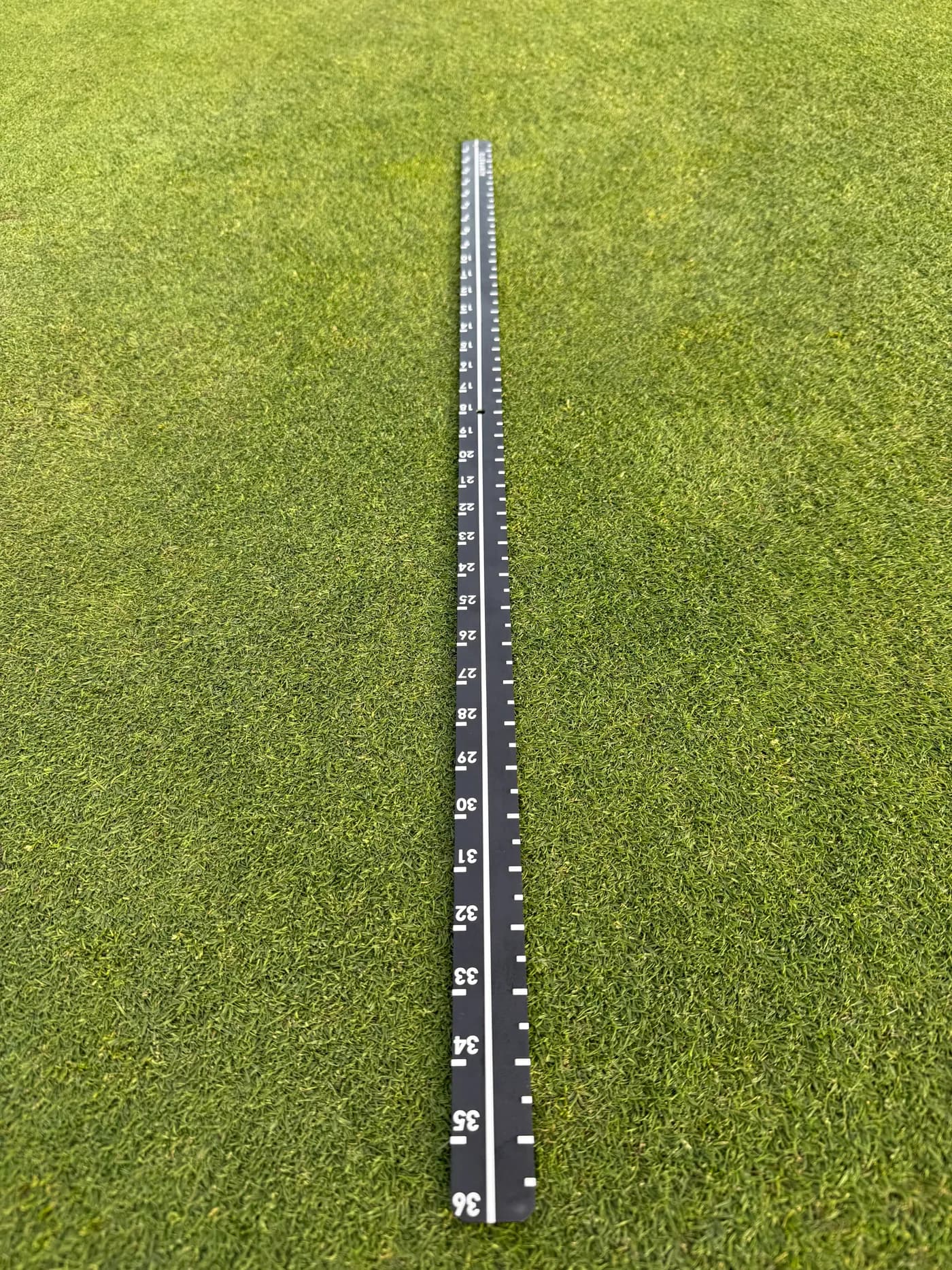
Most golfers end up with a drawer of single-purpose props — a gate here, a mirror there, tees, a metronome — and still no pace reference. AimPutt collapses the line tools and the missing pace tool into one 36-inch bar: the top rail trains stroke path and a square face (the gate and arc board in one surface), and the bottom rail carries a laser-etched pace chart mapping backswing length to roll-out distance. Line and pace, one tool, any flat surface. For what tour players lean on, see The Putting Aids Pros Actually Use.
Best putting training aid FAQ
What is the best putting training aid to start with? A gate, if your ball starts offline — it trains start line and a square face at once with instant feedback. If you three-putt a lot, prioritize a pace reference instead.
Do expensive putting aids work better? No. The best aids are simple and give clear feedback on one skill. What matters is that the aid isolates a skill and that you actually train pace, not just line.
What is the one thing most putting aids miss? Pace. Mirrors, gates, and arc boards all train line and setup; almost none calibrate how far a given stroke rolls the ball, which is what decides most three-putts.
Can I use putting training aids at home? Yes — nearly all of them work on a flat indoor surface. See Putting Practice at Home.
Want the line tools and the missing pace tool in one bar? Pre-order AimPutt - buy one, get one free. Estimated shipping is mid-October 2026.
Related reading: The Putting Aids Pros Actually Use · 7 Putting Practice Drills That Actually Lower Your Scores · How to Stop Three-Putting