
Best Putting Mats for Home Practice (and the One Thing a Mat Won't Fix)
A good putting mat gives you a true, repeatable roll and a target — it will not fix your stroke. How to choose one, what to ignore in the marketing, and the single skill no mat trains.
A putting mat is the most popular way to practice putting at home, and one of the most misunderstood. A good mat gives you a true, repeatable roll and a target. It will not fix your stroke. Here is how to choose one, what to ignore in the marketing, and the single skill no putting mat trains.
What a putting mat is actually good for
A mat gives you three things a bare floor does not: a consistent roll, a hole or target, and a flat, dedicated surface that makes practice a habit. For grooving your start line and building a daily routine, that is genuinely useful. What it is not is a coach — the mat gives you a place to putt, not feedback on how you putt.
What to look for in a putting mat
- A true, low-pile roll. Plush surfaces roll slow and inconsistent, which wrecks any pace work. Low pile rolls truer.
- Length. At least 8 to 10 feet if you want to train any distance at all. Short mats only train tap-ins.
- A flat backing that will not curl. A lip at the end of the mat sends putts offline and teaches you nothing.
- Simple alignment guides, not gimmicks. A center line helps. Auto ball-return is a convenience, not a training feature. Ramps that only feed makeable putts train the worst habit in putting.
Do you even need a mat?
Not strictly. A low-pile rug and a target work fine — see Putting Practice at Home. The mat's real value is a consistent roll and a fixed target so your feedback does not change session to session.
The one thing a mat won't fix
Here is the gap every putting mat leaves wide open: it gives you a surface, but no feedback on your stroke path, your face at impact, or how far a given stroke rolls the ball. Worse, most mats quietly encourage the single worst putting habit — rolling the same makeable eight-footer over and over, which trains nothing about pace. Line and pace are exactly what a mat leaves as a guess, and pace is what causes three-putts.
Pair a mat with a real stroke reference
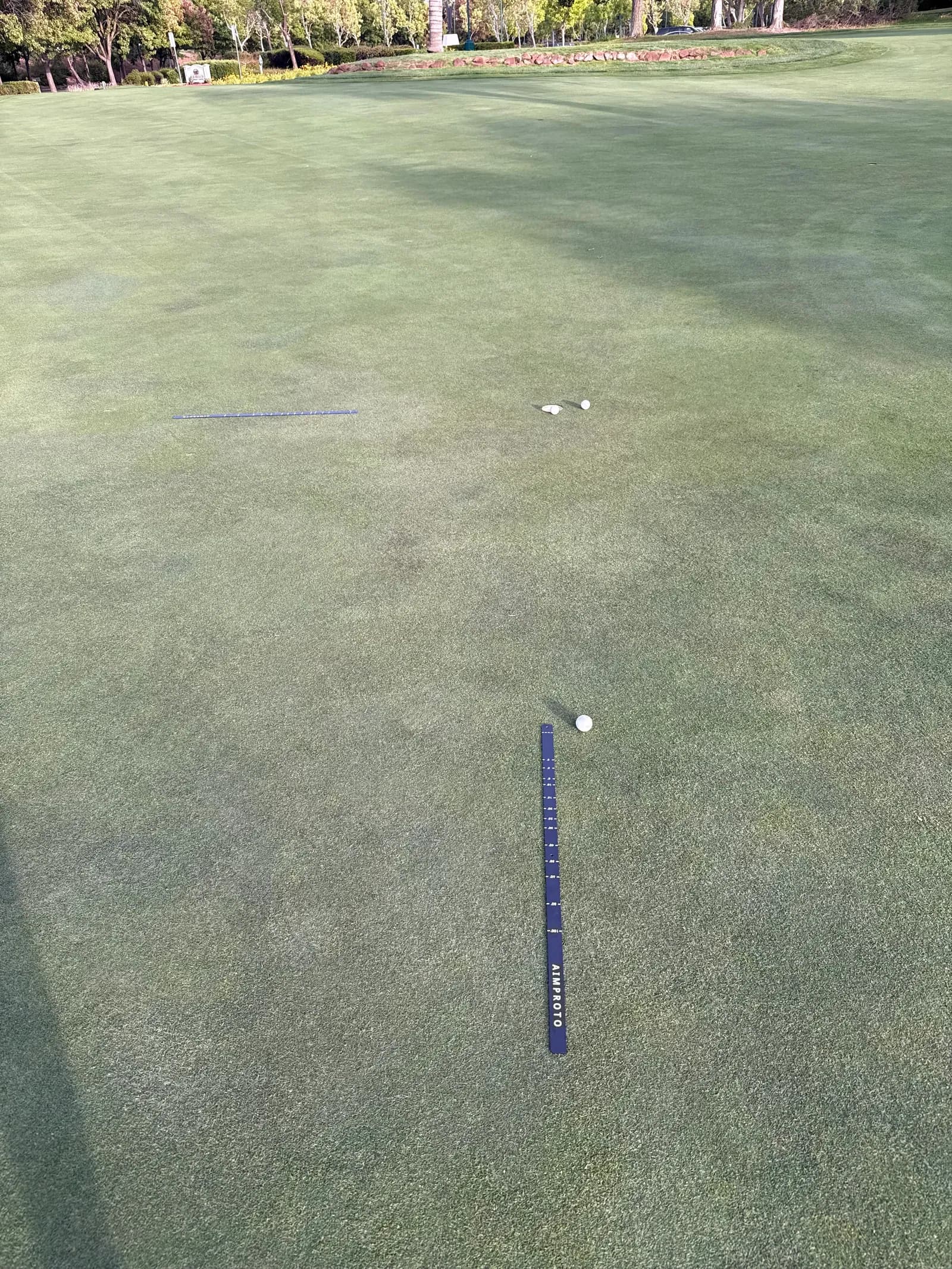
A mat plus a stroke reference is a real training station. AimPutt sits on any flat surface — your mat included — and closes the two gaps a mat cannot: the top rail trains stroke path and a square face, and the bottom rail carries a laser-etched pace chart that maps backswing length to roll-out distance. The mat gives you the roll; AimPutt gives you the stroke and the pace.
Putting mat FAQ
Do putting mats actually help you get better? For start line and daily reps, yes. Their limit is that they do not train your path, face, or pace — so a mat plus a stroke reference improves you far faster than a mat alone.
What is the best surface for a putting mat? Low pile. Thick, plush mats roll slow and inconsistent and ruin pace feedback. A truer, faster roll trains better.
How long should a putting mat be? At least 8 to 10 feet if you want to practice anything beyond tap-ins. Distance control needs room.
Is a putting mat better than a low-pile rug? Only marginally — the mat adds a hole and a consistent roll. Neither trains your stroke, which is the thing that actually needs work.
Want your mat to train pace and path, not just roll? Pre-order AimPutt - buy one, get one free. Estimated shipping is mid-October 2026.
Related reading: Putting Practice at Home · 7 Putting Practice Drills That Actually Lower Your Scores · How AimPutt Works